Maryland's Largest School District
MCPS is strengthening mathematics instruction to help every student build a strong foundation, develop confidence as a mathematical thinker, and be prepared for success in future mathematics courses and careers. Beginning next year, MCPS will implement a new instructional model aligned with guidance from the Maryland State Department of Education (MSDE), including expectations for acceleration and advanced learning opportunities.
As part of this work, MCPS will use a cluster grouping model for mathematics instruction. Cluster grouping is a research-supported approach that groups students with similar learning needs together for part of the instructional day within diverse school communities. This model is flexible and responsive to student progress, allowing students to move into advanced learning opportunities as they demonstrate readiness over time.
Classes will be organized to reduce the very wide range of instructional levels within a single classroom. This will help teachers provide more targeted instruction, meaningful enrichment, timely support, and appropriately challenging learning experiences for all students.
Students will be grouped in classes based on their learning needs and readiness levels. This approach helps teachers provide more targeted instruction, offer additional challenge when appropriate, and provide support more quickly when students need it. Groupings are flexible and may change over time as students grow, develop new skills, and demonstrate readiness for different learning opportunities.
This model will begin in 2026-2027 for Grade 4 students only, with additional grade levels the following year. If your child is in Grade 4, your school will be in touch soon to share more specific information.
Cluster grouping is a way of organizing classrooms so that students with similar academic learning needs can work together for part of the school day while still remaining part of a diverse classroom community. In this model, a small group of students with similar readiness levels is placed in a classroom with a teacher prepared to provide appropriately challenging instruction. This allows teachers to provide:
Cluster grouping is not a separate track or a system where students are isolated from peers all day. Instead, it helps teachers provide differentiated instruction more effectively, including enrichment, curriculum extensions, deeper conceptual learning, and accelerated pacing when appropriate.
This approach benefits all students by helping teachers plan instruction for a more manageable range of learning needs. For advanced learners, cluster grouping provides greater access to rigorous learning experiences, critical thinking and problem-solving opportunities, academic peers with similar learning pace, and consistent challenge and engagement in the classroom.
Our goal is to ensure that every student continues to grow academically each year, including students performing above grade level.
Cluster grouping is a research-supported instructional approach designed to ensure students receive the right level of support and challenge while continuing to learn in diverse grade-level classrooms. Unlike traditional tracking models, cluster grouping is flexible and responsive to student progress, allowing students to move into advanced learning opportunities as they demonstrate readiness over time.
This approach aligns with current research in advanced learning and with the Maryland State Department of Education’s 2026 Mathematics Acceleration Guidance, which identifies cluster grouping as “a research-supported strategy for meeting the needs of students experiencing success beyond expectations.”
Research from organizations such as the National Association for Gifted Children and other experts in gifted education shows that advanced learners often experience stronger academic growth, greater engagement, and increased motivation when they have opportunities to learn alongside intellectual peers. Research also shows that this approach does not negatively impact other students. In many cases, all students benefit because teachers are better able to provide targeted instruction and meaningful support across a more manageable range of learning needs.
Studies further suggest that cluster grouping can create more equitable access to advanced learning opportunities because it allows for flexible movement and ongoing identification over time. This can help ensure that students whose strengths emerge later, including multilingual learners and twice-exceptional students, have additional opportunities to access advanced instruction and enrichment. Overall, research indicates that cluster grouping is an effective way to support advanced learners while strengthening instruction for all students.
Support will include:
Teachers will continue to use flexible grouping, formative assessment, and targeted instruction to ensure all students are appropriately supported and challenged.
Cluster grouping decreases the range of students each teacher has to teach. Here is an example of how a school might create math classrooms. Each classroom has three student levels instead of five. It’s important to note that each school will have its own considerations based on the number of math classes and the needs of Emergent Multilingual Learners and Students with Disabilities.
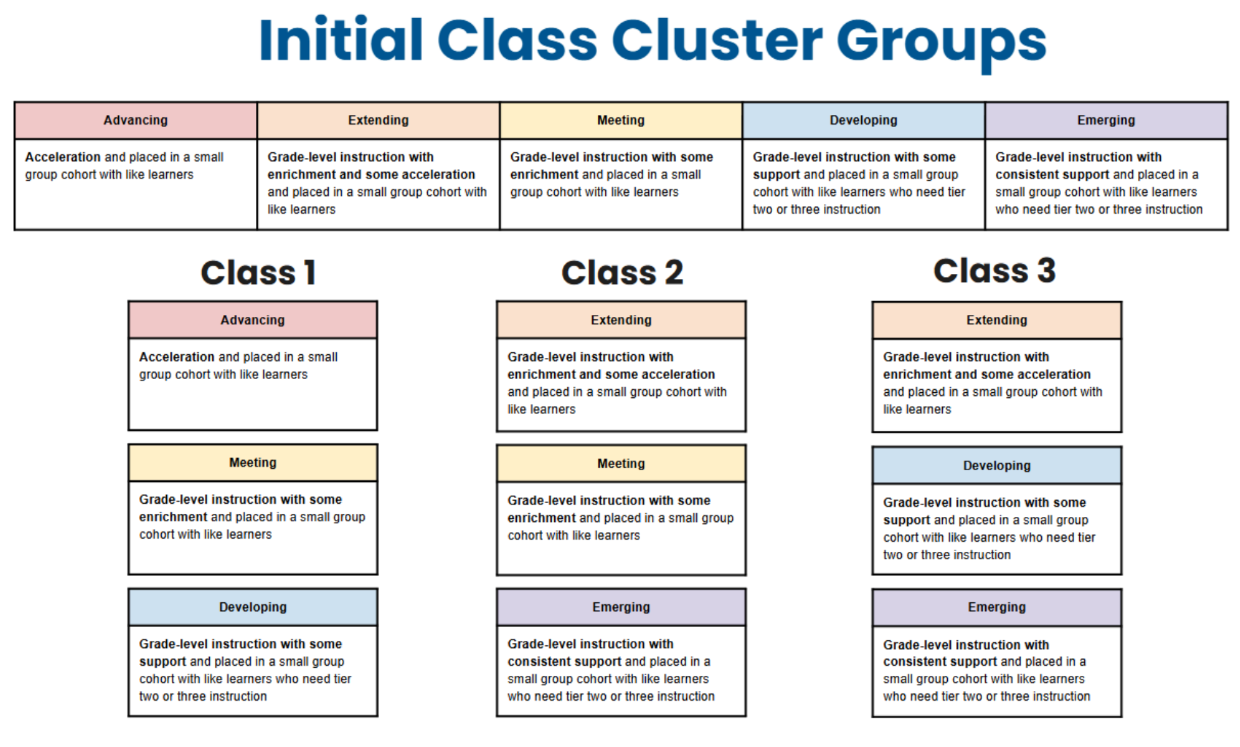
These are not fixed groups. Student may move between groups and between classes as needed based on data.
Students who are twice-exceptional (2e) and enrolled in accelerated mathematics will be supported through the same inclusive, research-based systems used to support all learners. Instruction will be grounded in Universal Design for Learning (UDL) to provide multiple ways for students to engage with content, access information, and demonstrate understanding. This allows students to participate in rigorous coursework while also addressing their individual learning needs.
Students’ needs will also be supported through existing structures such as 504 Plans and Individualized Education Programs (IEPs). These plans guide the use of accommodations, modifications, and services to ensure students have equitable access to accelerated math instruction.
For twice-exceptional students, identification for accelerated math must reflect a full and accurate picture of their abilities. This includes examining patterns of strengths and weaknesses within standardized assessment data, rather than relying solely on composite scores. Additional data available to the team should also be considered, including individual achievement measures, cognitive assessment data, classroom performance, formative assessments, teacher input, and student work samples. This is especially important for students whose strengths may not be consistently demonstrated on broad or single-measure assessments.
For many years, both pre-pandemic and post-pandemic, we have reviewed the district mathematics acceleration practices, student achievement data, external expert recommendations, and research on effective mathematics instruction. Our current compacted math model, which combines Grades 4, 5, and 6 content into a two-year sequence, has been in place for 17 years. While designed to increase rigor for advanced learners, student outcome data have not shown the level of long-term success we hoped for in Algebra and higher-level mathematics courses. Our trend data show that among our compacted math cohort of students, only 5% demonstrate the highest level of mastery in Algebra, while nearly half do not meet proficiency standards. As a result, we will offer a new acceleration model.
The implementation timeline is:
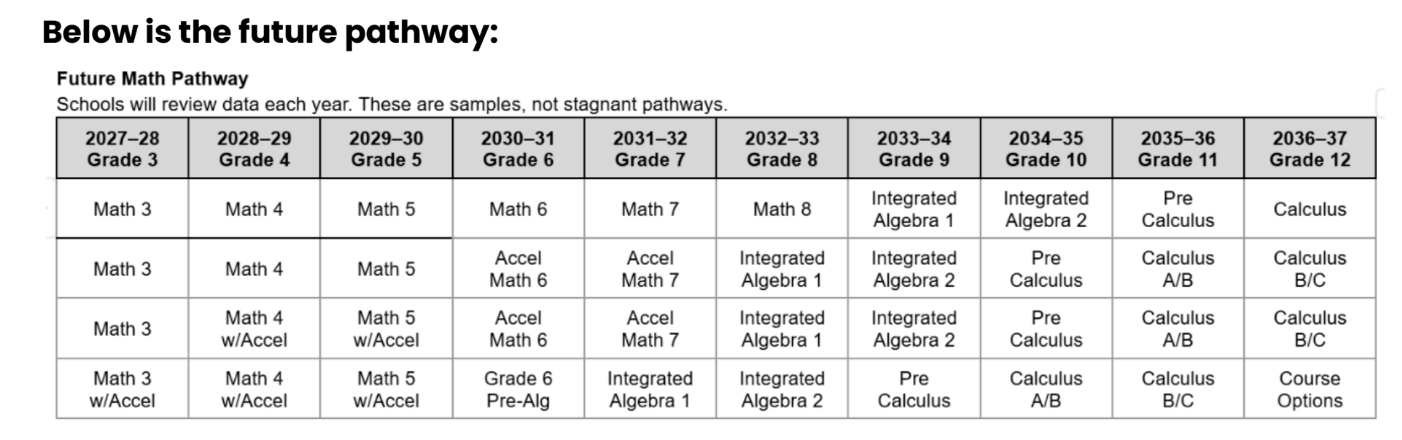
Students who are currently enrolled in the Grade 4/5 Compacted Math pathway will continue on that pathway and take Algebra 1 in Grade 7. As with all instructional pathways, there may be individual cases in which students follow a different trajectory based on student data and discussions between schools and families. This is our current practice.
The criteria will be posted shortly
The Amplify Desmos curriculum is designed to promote deep mathematical
thinking, problem solving, and conceptual understanding for all learners. Within this
framework, advanced students will continue to have opportunities for enrichment
and academic challenge.
Mathematics enrichment and acceleration may include:
The goal is not simply to move students through content faster, but to provide
meaningful instruction.
A strong foundation in algebra is important because it helps students develop the critical thinking, reasoning, and problem-solving skills needed for success in future mathematics courses, college, careers, and everyday life. The Maryland State Department of Education identifies Integrated Algebra I as a Grade 9 course. This means that students who complete Algebra in Grade 8 are already participating in an accelerated mathematics pathway.
Students who take Algebra in Grade 7 are progressing two years ahead of the state’s recommended sequence. Because of this, it is important that students build deep understanding, confidence, and long-term readiness for advanced mathematics as they move through accelerated coursework. Students who complete Algebra 1 in Grade 7 typically take four additional years of high school mathematics, for a total of six years of high school-level math courses.